September 2026 Seasonal Embodied Practice
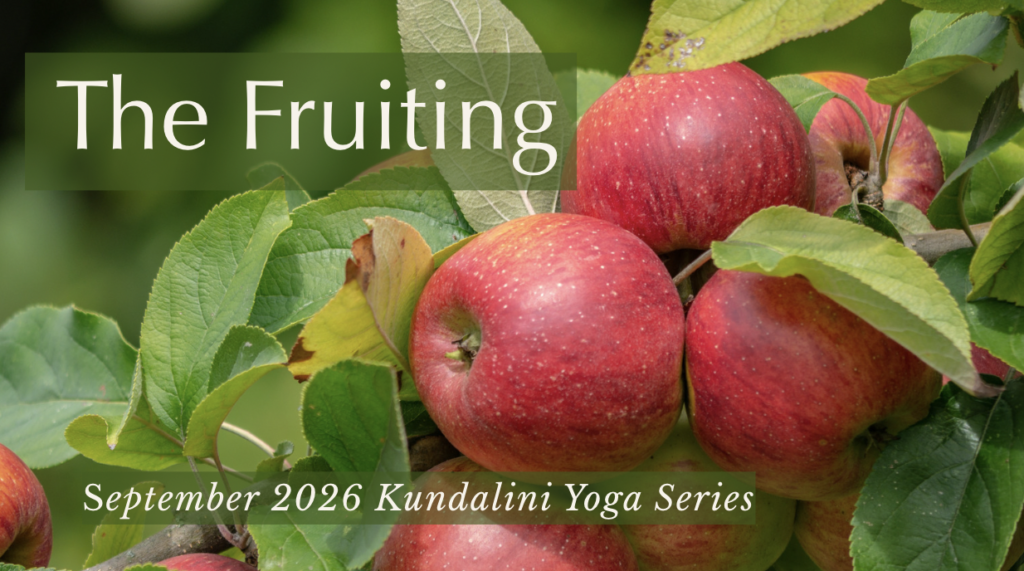
September brings a perceptible shift. Summer begins to yield to schedules, routines, school, and work. And in the orchard, the apples are coming into their own.
This month, the image of fruit becomes our doorway into one of the great paradoxes of the Bhagavad Gita.
On the battlefield of Kurukshetra, the warrior Arjuna finds himself unable to act. Those assembled before him include family members, teachers, and people he loves. He knows that whatever he does will have consequences, and he does not want to fight.
It is within this crisis that Krishna offers a teaching that has echoed across centuries:
You have a right to your actions, but not to the fruits of your actions.
This is not an invitation to care less about what we do or about the consequences of our actions. Arjuna cares deeply. Rather, Krishna challenges him to discern what is his to do—and then to act without making his willingness to act dependent upon the outcome he desires.
This is a demanding teaching.
We tend to connect effort with outcome: work hard and earn the promotion; nurture the relationship and expect it to flourish; devote ourselves to a project and hope to see it succeed.
Sometimes the expected fruit comes.
Sometimes it does not.
And sometimes our efforts bear fruit somewhere else entirely—in another person, at another time, perhaps even beyond our lifetime.
What, then, does it mean to act wholeheartedly while loosening our claim upon what our actions must produce?
Bringing the Question to Practice
The same inquiry can be brought to our Kundalini yoga practice.
We practice breath, kriya, meditation, and mantra, and naturally there may be benefits: greater steadiness, awareness, vitality, clarity, or an increased capacity to meet our lives.
But spiritual practice can also become transactional: I will do this practice so that this particular thing will happen.
What changes when we practice without demanding a particular experience in return?
Disciplined practice can create the conditions of receptivity. It cannot manufacture the numinous.
And there is another possibility we will hold during the month: perhaps the consequences of practice do not end with the practitioner.
In Mahayana Buddhism, for example, there is a tradition of dedicating whatever merit arises from spiritual practice to the benefit of all sentient beings. It offers a different way of considering fruit—not simply as something we acquire, but as something whose effects may move beyond us.
Perhaps not everything that ripens through our work or our practice is ours to possess—or even ours to witness.
The Four-Sunday Journey
Throughout September, this inquiry will unfold through Kundalini Yoga, pranayama, meditation, deep relaxation, and reflection.
Week 1 — Action: What Is Mine to Do?
We begin with Arjuna’s dilemma and the question of action itself. How do we discern what is ours to do when we cannot know or control the consequences? Our practice will explore presence, steadiness, and the capacity to act without certainty.
Week 2 — Fruit: Our Relationship to Outcome
We turn toward phala, the fruit of action. What happens when effort becomes entangled with expectation? We will explore the difference between wholehearted engagement and attachment to a particular result—not as indifference to outcome, but as another way of meeting uncertainty.
Week 3 — Beyond the Individual
What if the effects of our practice extend beyond the person doing the practice? Drawing upon contemplative traditions that widen the intention of practice beyond individual benefit, we will explore what happens when the question shifts from What will this do for me? toward What might move through me into the larger world?
Week 4 — Offering: Tending Without Knowing
We return to the orchard. We have tended, practiced, and acted—but we cannot command what ripens. Our final Sunday will explore offering, receptivity, and the possibility of participating in something larger than the outcomes we can see or measure.
We do not need to know in advance where this inquiry will take us.
We labor. We tend. We practice.
The fruit may come as we hoped. It may appear in a form we never anticipated. It may nourish someone else. It may ripen long after we are gone. Or the particular fruit for which we labored may never appear at all.
We do not know.
And still we tend the orchard.
Series Details
- Four Sundays: September 6, 13, 20 & 27
- Time: Sundays at 12:00 PM Eastern / 9:00 AM Pacific
- Format: Live online via Zoom
- Recordings: All registered participants receive access to the class recordings and may practice at their own pace throughout the month.
- Suggested Contribution: $49 for the four-class series (pay what you are able; all are welcome).
What to Expect
Each 75-minute gathering includes:
- Centering and Pranayam
- Kundalini Yoga Kriya
- Guided Deep Relaxation
- Meditation
- Reflection inspired by Jungian Depth Psychology, mythology, and contemplative practice
- Optional Community Integration time following each class
Whether you are new to Kundalini Yoga or have practiced for many years, every practice is invitational and may be adapted to honor your own body, experience, and comfort level. If movement is limited, you are warmly invited to participate through visualization. Many students find the breathwork, meditation, and guided relaxation to be among the most meaningful aspects of the practice.
About Your Teacher
Founder, MetaHeart Center
Embodied Archetypal Wisdom & Contemplative Practice
Kundalini Yoga • Jungian Depth Psychology • Mythology • Contemplative Practice
For more than three decades, I have explored the intersection of science, psyche, and contemplative wisdom. My work integrates a background in medical biology, Jungian depth psychology, HeartMath, mythology, and Kundalini Yoga to create practices that invite not only stress reduction, but meaningful inner transformation.
At MetaHeart Center, yoga is more than physical exercise. It becomes an embodied conversation between body, psyche, and spirit—a place where ancient contemplative traditions and modern psychological understanding meet in service of the unfolding Self.
Disclaimer
These classes are offered for educational and experiential purposes only and are not a substitute for medical, psychological, or psychiatric care. Please consult your healthcare provider before beginning any new physical, breath-based, or meditative practice.
All practices are invitational. Participants are encouraged to honor the wisdom and limits of their own bodies, modifying or discontinuing any exercise that feels inappropriate or unsafe. By participating, you acknowledge personal responsibility for your physical, emotional, and psychological well-being.
This series integrates Kundalini Yoga, Jungian Depth Psychology, mythology, contemplative traditions, and symbolic reflection as educational and experiential frameworks for personal exploration. While Kundalini Yoga was popularized in the West through various lineages, including that of Yogi Bhajan, I do not endorse or condone the harmful actions and abuses he has been accused of. My teaching is informed by years of study, personal practice, depth psychological inquiry, and deep respect for the timeless wisdom that transcends any one individual or organization.